A dark entryway can be a real design challenge. It’s a space that often has no access to daylight, is narrow, long, full of doors, and difficult to furnish functionally. And yet it’s the first area that greets household members and guests. The good news? A full remodel isn’t always needed to change how it looks. Sometimes the right mirror, appropriate lighting, and a thoughtful color palette are enough to achieve a surprisingly fresh effect.
In this guide, we’ll show how to visually enlarge a dark entryway with mirrors, where it’s best to hang a mirror, which models work in a small entryway, and what to pair them with to visually expand the space, add light, and bring elegance.
Why is a mirror the best ally of a small entryway?
Mirrors have long been one of the simplest tricks used in interior design. Their power lies in the fact that they reflect light, colors, shapes, and parts of the room, making the interior feel less closed in. A well-placed mirror visually enlarges the space, gives it breathing room, and makes even a small hallway look more polished.
In a dark entryway, a mirror serves several functions at once:
First, it’s practical because it lets you check your appearance before heading out.
Second, it brightens the space, since a mirror reflects light from lamps, wall sconces, open doors, or adjacent rooms.
Third, it creates an illusion of depth, making the space seem wider, taller, or longer, depending on the mirror’s shape and where you install it.
That’s why a mirror is so effective when you want visual enlargement without tearing down walls, changing the layout, or undertaking an expensive remodel. All it takes is to use its potential intentionally.
Where should you hang a mirror in a dark entryway?
Placement matters a lot. Even the most beautiful model won’t do its job if it’s hung at random where it reflects a dark wall, clutter, or bulky furniture. If you want to visually enlarge the interior, first look at what the mirror will show.
You’ll get the best effect when the mirror is placed opposite a light source. This could be a ceiling light, a sconce, a door with glass, an opening to the living room, or a window visible from another room. If your layout allows, hang a mirror opposite a window. Even if the window is in the next room, the pane will catch natural light and distribute it through the entryway, brightening the interior.
In a narrow hallway, a mirror on the longer wall works very well. This visually pushes the walls apart and helps break the tunnel effect. If you’re arranging a narrow entryway, choose a larger pane or several smaller mirrors arranged in a single line. This makes the room feel less cramped and the whole interior more open.
A mirror by the front door is also a good idea. It’s practical, combining everyday convenience with a decorative effect. Just be sure the pane doesn’t reflect scattered shoes, a heavy coat rack, or dark built-ins. A mirror can enlarge—but it can also duplicate chaos.
What mirror should you choose for a small, dark entryway?
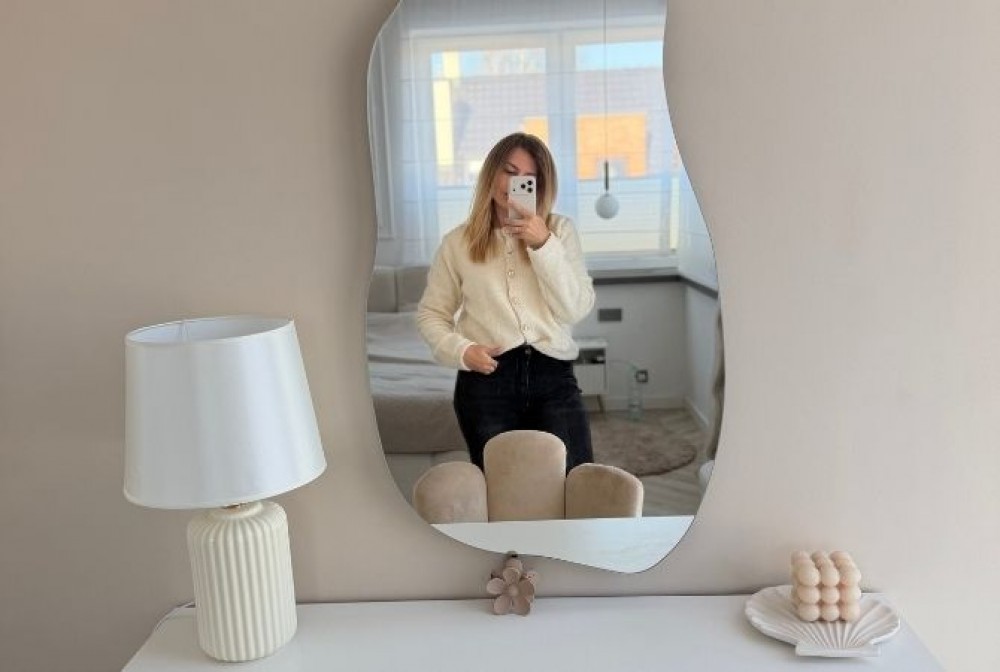
If you’re looking for the ideal mirror for a challenging space, pay attention to three elements: size, shape, and finish. In small interiors, a large mirror works best, because the larger the reflective surface, the stronger the sense of spaciousness. A large pane not only reflects more light but also adds depth, making it easier to enlarge the space without physically altering the room’s layout.
In an entryway with a low ceiling, choose a vertical mirror. The slender form draws the eye upward, helping to increase the perceived height of the space.
In long and narrow spaces, horizontal mirrors work better, visually stretching the wall. This is an especially good choice in long corridors where we want to break the proportions.
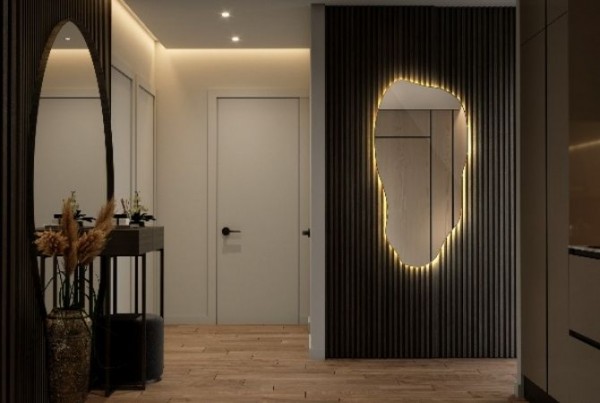
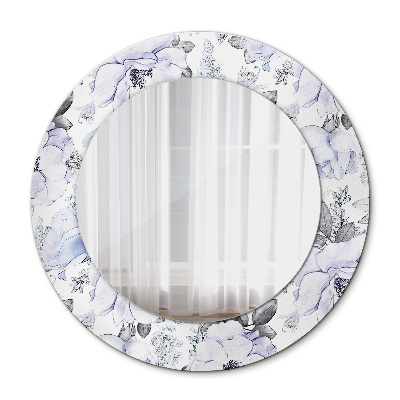
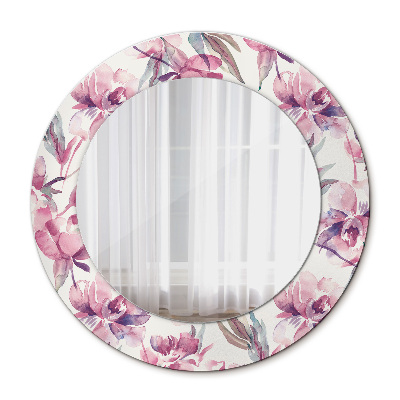
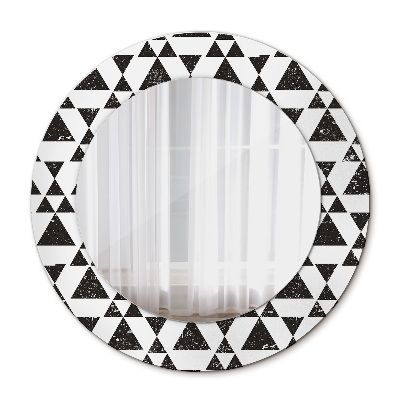
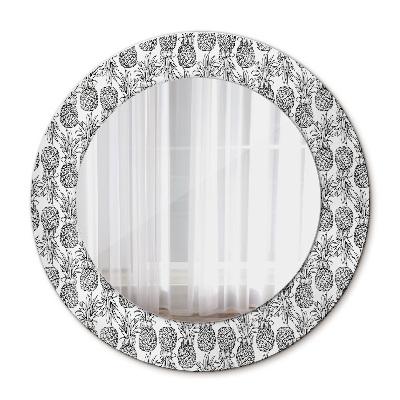
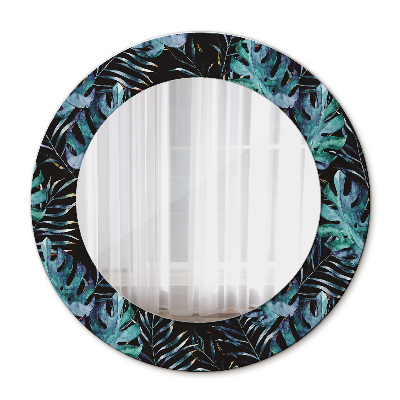
An interesting option is also a round mirror. Its soft line eases the sharp angles that are usually plentiful in an entryway. Doors, closets, tiles, trim, and built-ins create many straight edges, so a round pane brings lightness and pleasant harmony. In a thin metal frame it can add elegance, and a model with LED backlighting gives the space a modern character.
In small spaces, it’s best to avoid very heavy, dark, and richly ornamented frames. They can look striking, but in a tight hallway they easily create visual overload. If you want to avoid a weighed-down effect, choose mirrors with light frames, frameless models, or mirrors with delicate finishes in silver, gold, white, or light wood.
A mirror as a way to visually enlarge a space
A well-chosen mirror is one of the most effective ways to visually enlarge a space. It works like a window—it opens up a wall, reflects light, and creates an extra dimension. In a small entryway, the effect can be truly spectacular, especially if you combine the mirror with light walls and well-planned lighting.
It’s worth remembering that mirrors work not only in corridors. The same rules apply when we want to visually enlarge a living room, visually enlarge a room, or make a room in a small apartment feel bigger. The difference is that an entryway usually has less space, less light, and more utilitarian elements, so every detail matters more.
If you want to visually enlarge a small entryway, avoid tiny mirrors hung randomly above a console. Instead, opt for one larger pane, a mirror on a closet door, or mirrored wall panels. Such mirrored surfaces make the room’s boundaries less obvious and give the interior lightness and elegance.
Mirrored wall panels and sliding doors - solutions for truly small spaces
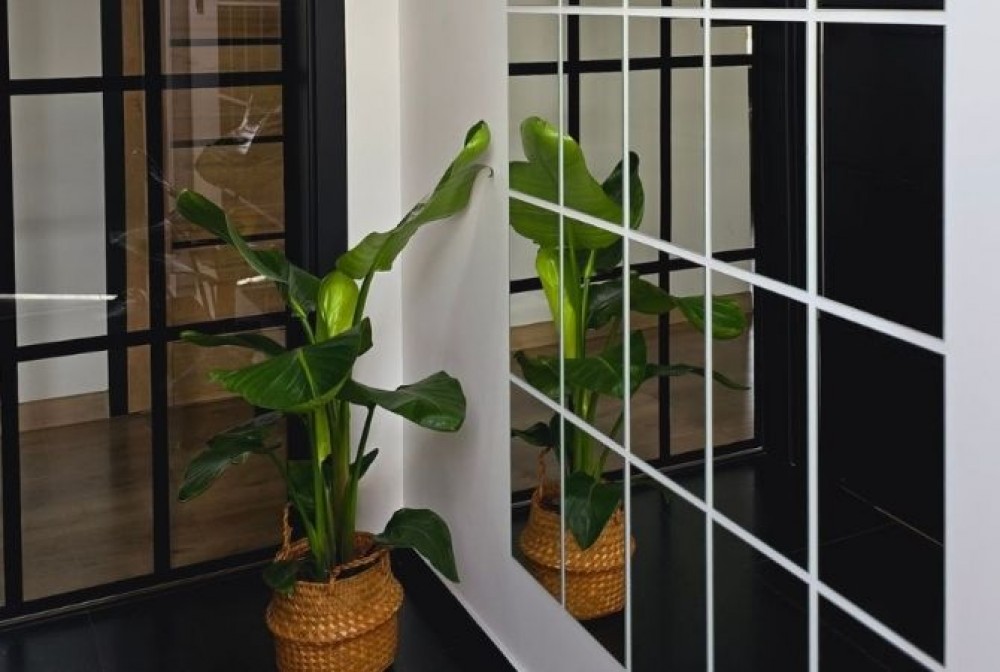
In very small apartments, a classic mirror may not be enough. Then it’s worth considering solutions that combine aesthetics with functionality. A good example is wall panels with a mirrored finish. You can install them on part of a wall, by a console, next to a closet, or along the entire length of the hallway. Mirrored wall panels work especially well where we want a strong sense of spaciousness without adding more decor.
Closets with mirrored fronts or sliding doors with a mirror are also great solutions. Such built-ins use the available space for storage while helping to visually enlarge the entryway. In practice, that means fewer visible items, more order, and a stronger light-reflection effect.
It’s worth choosing built-ins with light fronts, especially if the hallway is dark and narrow. The combination of a mirror with white, beige, light wood, or soft grays creates a harmonious whole. Thanks to this, even a room with limited square footage can look fresh, light, and welcoming.
Wall colors that reinforce the mirror’s effect
A mirror works best when it has something to reflect. If dark colors dominate around it, the effect may be weaker and the space may still look gloomy. That’s why choosing wall colors is so important. In a dark entryway, light wall colors work best, such as white, cream, beige, light gray, pastel blue, or a warm sandy hue.
Light walls reflect light, and combined with a mirror, they amplify the sense of spaciousness. If you want a soft, elegant effect, choose paints in shades of white or warm neutrals. Light colors don’t have to be boring—they can create a subtle backdrop for a decorative mirror, stylish lighting, and practical furniture.
An interesting trick is the principle of perspective contrast. If the entryway is very long, paint the shorter wall a slightly darker or warmer color to visually shorten the tunnel-like layout. In that case, treat the shorter wall as an accent, but keep the other surfaces light. This way you’ll maintain balance and avoid a heavy feel.
Lighting that works with a mirror
In a dark entryway, the mirror and light should work as a duo. The pane alone won’t brighten the interior if there’s no light to reflect. That’s why it’s worth planning multi-point lighting near the mirror. Instead of a single central lamp that often creates shadows, it’s better to use several light sources: a ceiling fixture, wall sconces, LED strips, lighting by the closet, or backlighting of the mirror itself.
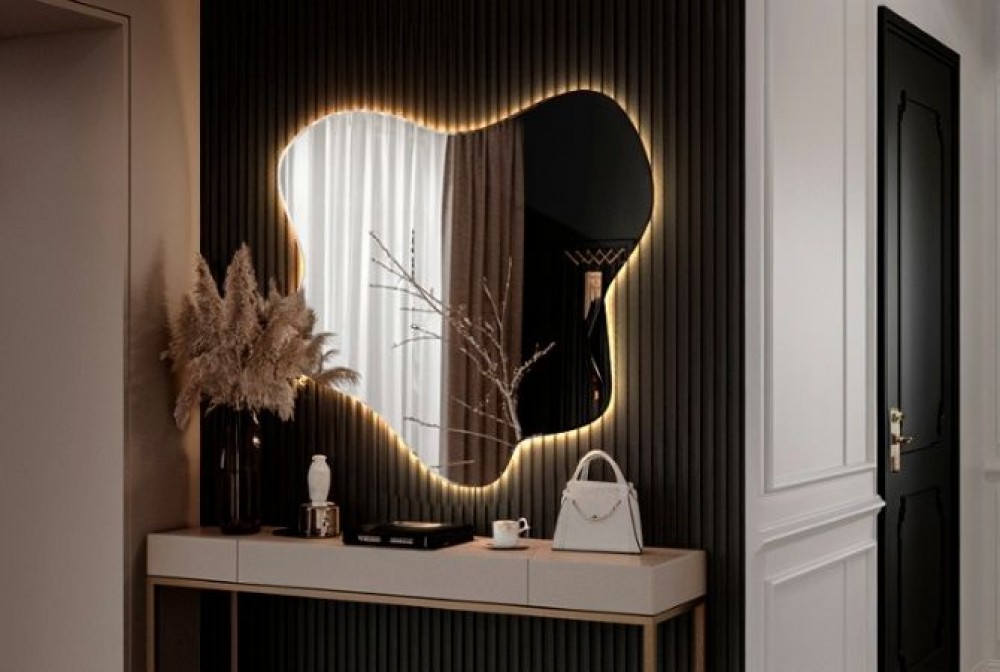
An LED mirror is an excellent choice for an entryway without a window. The soft glow around the pane not only makes the mirror easier to use but also gives the space a pleasant ambiance. This model works great in modern arrangements where simplicity, functionality, and elegant detail matter.
If natural light reaches the entryway from the kitchen, living room, or a bedroom, position the mirror to catch it. In homes where the living room connects to the hallway, the effect can be especially beneficial. Open sightlines and reflections make the boundary between rooms feel more fluid, and the entryway gains more light.
Furniture for a small entryway - what to choose and what to avoid?
Even the best mirror won’t help if the entryway is cluttered. In small rooms, every inch counts, so it’s worth limiting furnishings to what’s most needed. Instead of large dressers and heavy wardrobes, choose shallow cabinets, narrow consoles, lightweight seating, and furniture on tall legs. This reveals the floor, and the more visible the flooring, the more spacious the room feels.
Avoid bulky furniture that overwhelms the entrance from the start. In small rooms, simple forms, light materials, and fronts without too many handles work better. If a closet has to be large, let it have mirrored doors or a light finish. Then instead of weighing down the space, it will start to work with it.
Closed storage systems are also practical. Shoes, bags, umbrellas, and accessories should have their place, because the mirror will reflect everything that’s opposite. Order is one of the cheapest ways to strengthen the sense of spaciousness.
Is it worth hanging mirrors opposite each other?
Mirrors have enormous potential, but they must be used with sensitivity. Installing mirrors opposite each other can create an interesting, almost gallery-like effect, but in a small and dark entryway it won’t always be the best choice. Multiple reflections can introduce visual restlessness, especially if the panes show doors, hooks, closets, or lots of small items.
If you want an elegant effect, it’s better to choose one dominant mirror and possibly complement it with smaller mirrored elements. This way you’ll maintain control over what appears in the reflection, and the whole interior will look calmer.
It’s also worth paying attention to finish details. Light flooring, subtle trim, good lighting, and cohesive accessories help create a refined composition. Even elements at the baseboards can influence the overall perception—dark, strongly contrasting bands can visually lower or narrow the space, while lighter finishes add lightness.
How to avoid the most common mistakes?
The biggest mistake is choosing a mirror that’s too small. A small pane can be practical, but it rarely provides a clear visual enlargement. If you truly want to transform the entryway, choose a larger model or several mirrored elements arranged in a cohesive composition.
The second mistake is installing a mirror where it reflects a dark corner, utility doors, or a cluttered part of the home. A mirror should show the best: light, a bright wall, a nice decoration, an opening to the living room, or an orderly space. Then the effect will be natural and aesthetically pleasing.
The third mistake is pairing a mirror with an excess of dark colors. Of course, dark accents can look beautiful, but in a corridor without a window they need to be used carefully. A safer choice is a light color palette, complemented with contrast in accessories, for example a black handle, a graphite hook, or a gold mirror frame.
The fourth mistake is a lack of proper lighting. If you want the mirror to truly work, take care of your lighting. Well-positioned light and a mirror can achieve a spectacular effect together.
A mirror in the entryway of small apartments
With a mirror, you can transform even a very challenging entryway. It’s a detail that works for the interior every day: it reflects light, improves proportions, decorates the wall, and makes everyday outings easier. A well-chosen mirror can visually enlarge, brighten, and organize the space without major expense.
The key is to treat the mirror not as a random accessory, but as a deliberate design element. Choose the right size, hang it where it will reflect light, and pair it with light walls and airy furniture. This way even a dark, narrow, and awkward entryway can become a place that looks stylish, fresh, and inviting.